
Are All Four Legs of a Four-Leg Sling Really Carrying Load?
Four-leg slings are often taken for granted as "sharing the load evenly across all four legs". Yet on-site measurements and general calculations show that under common conditions such as an offset centre of gravity, length tolerances between legs, and excessively large sling angles, only two or three legs are actually carrying the load, and the tension in a single leg can reach 1.5–2 times — or even more — the theoretical value for a vertical lift. When placing an order, the actual lifting weight must be stated clearly so that the configuration can be customized to suit that weight.
I. Are All Four Legs Loaded? First, Lay Out the Conditions for the "Ideal Case"
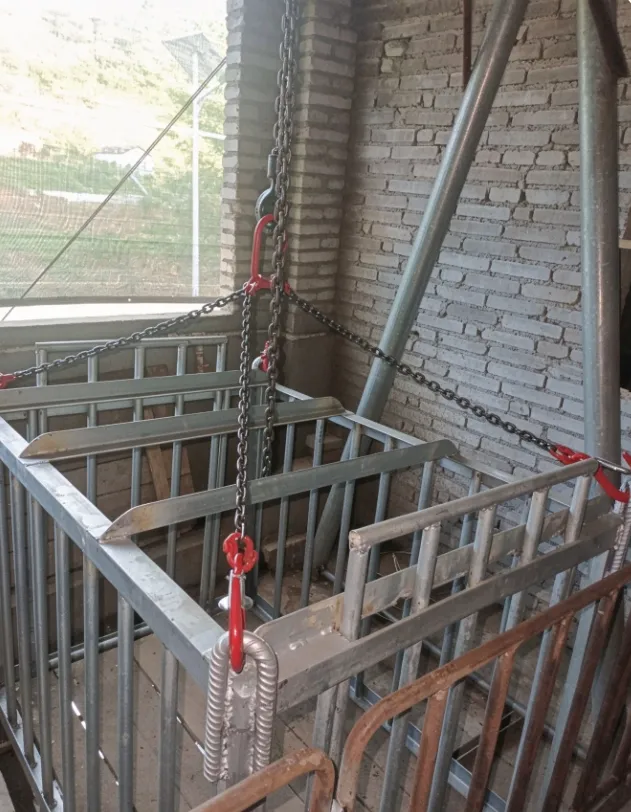
For a four-leg sling to achieve even load distribution across all four legs, four conditions must be met at the same time: the centre of gravity of the load coincides exactly with the geometric centre of the four lifting points; the effective working lengths of the four legs are exactly identical; the load direction on the four hooks is vertically downward; and the load is a rigid body with no twisting during the lift. If any one of these conditions is not met, the load concentrates on "the shortest leg and the highest corner". Place your order according to the actual load capacity you require from the four legs.
II. The Fourth Leg Is on "Standby": This Is How the Load Shifts Outward
1. Offset centre of gravity:
the centre of gravity of moulds, machine frames and box-type loads is rarely exactly centred. When the centre of gravity shifts toward one corner, the leg at that corner may carry 40%–50% of the total weight, with the other three legs together accounting for less than 60%.
2. Length tolerances:
the accumulated tolerance in chain link length and the uneven initial elongation of polyester slings mean that a length difference of 0.5%–1%, acting on a rigid load, is enough to make the shortest leg carry a disproportionate share of the load.
3. Excessive sling angle:
the larger the angle between a leg and the vertical, the greater the horizontal component, and the tension in a single leg increases proportionally. Once the angle exceeds 90°, the level of risk is completely different.
III. Three Hard Rules for On-Site Operation
1. The hook of a four-leg sling must be positioned directly above the centre of gravity of the load. Before the actual lift, perform an inch-up test lift, holding the load 100–200 mm above the ground to confirm there is no slipping and no abnormal tilting.
2. In principle, the angle between legs must not exceed 90°. Where it does, install a spreader beam or equalizing beam rather than simply increasing the sling's tonnage to force it.
3. Carry out a visual inspection before every use: tags legible, all four legs of equal length, chains/slings free of deformation and cuts, and end fittings free of opening-up and cracks.
IV. Inquiries, Price Comparisons and Trial Orders Welcome
Hebei Shengyu Lifting Machinery Manufacturing Factory produces four-leg slings year-round, covering a 1–50 t capacity range, and supports single-, two-, three- and four-leg configurations as well as customized spreader beam solutions. Sample units are available for on-site trial lift verification.
New and existing customers are welcome to inquire, compare prices, request samples for trial orders, discuss bulk purchases, or place orders directly — whether it is a single set on trial or a full container of bulk purchases, a written technical confirmation based on the five clauses above can be provided before the contract is signed and production scheduled.
Tel: 15133220087 (same as WeChat) | Email: Kate@syhoist.com
Related News
- Why Are Four-Leg Chain Slings Becoming Increasingly Popular?
- Why Choose G80 Manganese Steel Lifting Chain for Heavy-Duty Lifting?
- Is the Electric Winch Evenly Dissipated in Heat?
- Why Choose Ratchet Tensioners for Cargo Securing?
- Functions of the Gearbox for Electric Winches
- Advantages of Double Drum Electric Winch
Leave me a message