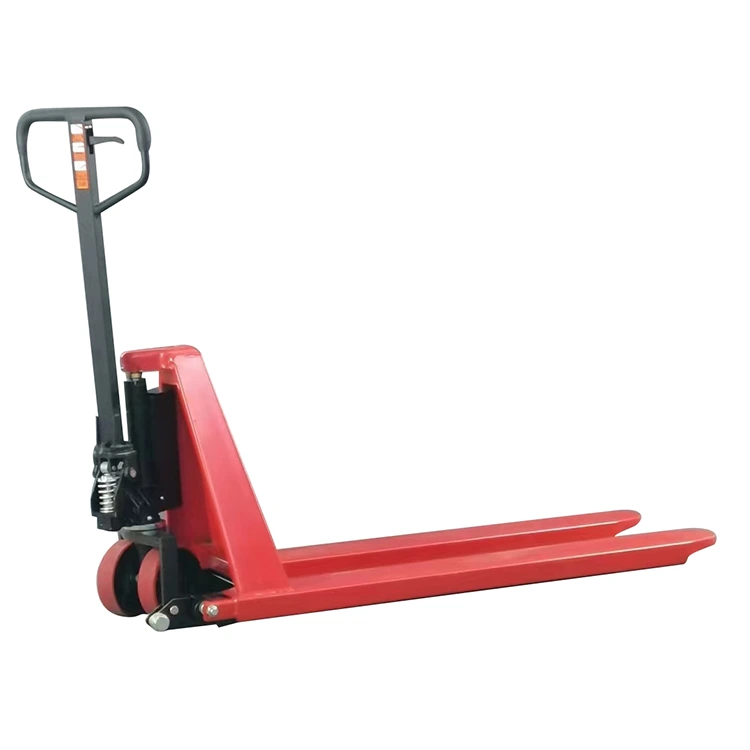

How to maintain a pallet truck?
Proper maintenance of a pallet truck will extend its lifespan. Maintenance focuses on checking the oil, removing air, and lubricating the truck.
It's best to check the oil level every six months. New oil should be filled into the rubber container 5mm below the liquid level, and the truck should be in the lowest position when adding oil. When replacing seals, air may enter the hydraulic system. Place the joystick in the lowest position and then rotate the handle a dozen times. Lubricate moving parts with motor oil or lubricant. Daily inspection and maintenance are also essential. Checking the truck can minimize wear, paying particular attention to the wheels, axles, forks, and lifting and lowering controls. Upon completion of each workday, the forks should be unloaded and lowered to their lowest position.

General daily maintenance measures include:
1. Daily maintenance, performed after each shift.
2. Level 1 technical maintenance, performed after 100 cumulative working hours (equal to two weeks per shift).
3. Level 2 technical maintenance, performed after 500 cumulative working hours (equal to one quarter per shift).
Daily Maintenance
1. Clean dirt, mud, and grime from the forklift, focusing on the fork carriage and mast slides, generator and starter, battery pole forks, radiator, and air filter.
2. Check the tightness of all parts, focusing on the fork carriage support, lifting chain tensioning screws, wheel bolts, wheel retaining pins, brake, and steering gear screws.
3. Check the stability and flexibility of the steering gear.
4. Check for leaks, focusing on the following: pipe joints, diesel tank, engine oil tank, brake pump, lift cylinder, tilt cylinder, radiator, water pump, engine oil pan, torque converter, transmission, drive axle, final drive, hydraulic steering gear, and steering cylinder.
5. Check tire pressure: If insufficient, refill to the specified value and confirm there are no leaks. Inspect the tire contact patch and sidewalls for damage and rim deformation. 6. Checking the Brake Fluid and Water Levels: Verify that the brake fluid level is within the specified range and check for air in the brake lines. When adding brake fluid, prevent the entry of dust and water. Use clean tap water when adding water to the radiator. If antifreeze is used, add the same antifreeze. Do not open the radiator cap when the water temperature is above 70°C. When opening the cap, use a thin cloth under the cap and do not wear gloves when unscrewing the cap.
7. Checking the Engine Oil, Hydraulic Oil, and Electrolyte Levels: First, remove the oil dipstick, wipe the tip clean, then insert and remove pallet truck to check if the oil level is between the two scale lines. The oil level in the working oil tank should be between the two scale lines. Too little oil will cause air to enter the lines, while too much oil will cause it to overflow from the cover. The battery electrolyte level should also be between the upper and lower scale lines. If insufficient, add distilled water to the top line.
8. Checking the Brake Pedal, Inching Pedal, Clutch Pedal, and Handbrake: Depress each pedal to check for any unusual sluggishness or sticking. The handbrake handle force should be less than 300N to confirm that the handbrake is secure and reliable.
9. Check belts, horn, lights, and instruments: Check that the belt tension meets the specified requirements. If there is no adjustment margin or if it is damaged or cracked, replace it. The horn, lights, and instruments should all function properly.
10. Remove any sediment from the oil filter.
Related News
- How Does the Electric Winch Perform Lifting in Confined‑Space Environments?
- How to Hoist with Simple-Steel-Frame Electric Winch?
- Can a Flexible Lifting Sling Cut by the Load's Sharp Edge Still Be Used?
- How Risky Is It Really When Chain and Load Binder Sizes Don't Match?
- What is the Function of the Rope guide for Electric Winches?
- What Scenarios Are Electric Winches Suitable For?
Leave me a message