

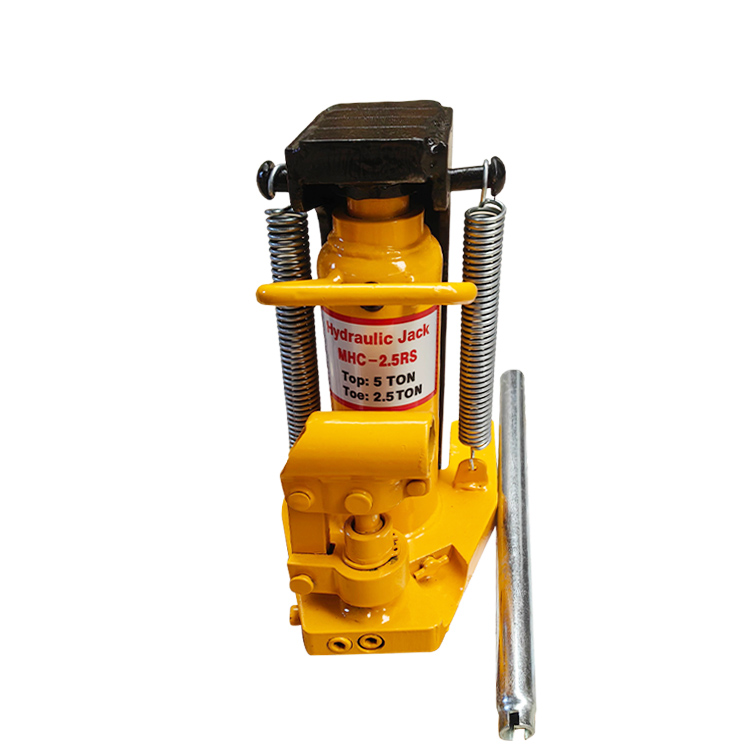
Claw Type Jack
Shengyu, as a professional lifting jack manufacturer and supplier in China, we would like to provide you customized claw type jack, also known as the rack jack, lifting machine, or "old-timer," is a simple, sturdy, and durable manual mechanical lifting device that use a lever and ratchet mechanism to drive a rigid support rod with a rack (main rack rod) to perform vertical reciprocating motion within the machine body. With a unique low-profile claw design, they access ultra-low ground spaces and lift objects from the bottom edge (not just directly beneath), requiring no external power and excelling in harsh working conditions.
High quality claw type jack prouced by Shengyu Hoisting Machinery factory is a portable tool that uses manual lever operation to drive the vertical movement of the rack to lift heavy objects. Known for its extremely low starting height, strong load-bearing capacity, sturdy mechanical structure, and independent portability. Although the lifting stroke is limited and the operating speed is slow, it plays an irreplaceable role in fields such as railway, construction, logistics, rescue, and heavy equipment maintenance that require low effort or harsh environments.
Classification
1.Classified by carrying capacity (main parameter):
Light weight: 0.5 tons, 1 ton, 1.5 tons
Medium size: 3 tons, 5 tons, 8 tons, 10 tons
Heavy duty: 15 tons, 20 tons, 30 tons, 50 tons, 100 tons and so on.
2.Classified by driving method:
Manual lever type: the most traditional, operated by reciprocating the lever.
Hand cranked: Drive the gear rack by turning the handle, which is more labor-saving.
3.Classified by Function/Design:
Standard claw jack: universal type.
Adjustable high claw jack: The top saddle height can be adjusted to adapt to different loads.
Product Parameter
| Model | MHC-2.5RS | MHC-5RS | MHC-10RS | MHC-15RS | MHC-25RS | MHC-50RS |
| Size(L*W*H) | 210x140x232 | 260x200x283 | 295x220x322 | 305x255x350 | 340x285x350 | 570x440x430 |
| Claw lowest position(mm) | 20 | 20 | 25 | 30 | 50 | 50 |
| Claw width E(mm) | 65 | 100 | 115 | 130 | 130 | 220 |
| Claw length F(mm) | 45 | 50 | 55 | 60 | 65 | 60 |
| Elevation(mm) | 115 | 148 | 158 | 158 | 150 | 150 |
| Top rated load(T) | 5 | 10 | 20 | 30 | 50 | 100 |
| Bottom rated load(T) | 2.5 | 5 | 10 | 15 | 25 | 50 |
| Weight(KG) | 11 | 24 | 36 | 55 | 75 | 189 |
Product Application
Railway maintenance: Claw type jacks made in China can be used to lift railway tracks for replacing sleepers and adjusting track gauge, therefore also known as initial track lifting.
Heavy equipment maintenance: Lifting the axles or chassis edges of heavy machinery, machine tools, and large vehicles at construction sites or workshops.
Architecture and Steel Structures: Installation and adjustment of large prefabricated components and I-beams.
Logistics and Warehousing: Mobile Heavy duty Shelves, Mechanical Equipment。
Rescue and emergency response: Lift heavy objects and open up rescue channels at disaster sites with limited space.
Features:
Extremely low starting height: The unique claw design of claw type jack can extend into gaps as low as 10-30 millimeters, which is an advantage that other jacks cannot replace.
Strong structure, durable and reliable: The all metal mechanical structure is impact resistant, wear-resistant, and has a long service life.
Not dependent on external power: Pure manual operation, no need for electricity or hydraulic oil, suitable for outdoor and non electric environments.
Strong load-bearing capacity: Mechanical rack and pinion transmission can withstand extremely large loads and has a wide tonnage range.Better bear capacity, machine bear through can conpact bigger loading weight, then loading weight function will more wider than others.
Simple maintenance: intuitive structure, few faults, usually only requiring cleaning and lubrication.
How to choose right claw type jack?
Determine maximum load: Choose a jack with a rated load that is at least 20% -30% higher than the maximum weight of the object to be lifted. Do not overload.
Confirm starting height: Measure the minimum height of the space that needs to be extended, ensuring that the claw height of the claw type jack is below this value.
Confirm the required travel: Calculate the lifting distance required from the starting position to the target height, ensuring that the maximum lifting height of the jack meets the requirements
Evaluate usage frequency and environment: choose heavy-duty dual track for high-intensity and frequent use; Occasional use or light load optional monorail. Attention should be paid to rust prevention in damp and dusty environments.
Usage noted
Safety important:
When lifting heavy objects, it is strictly prohibited to place any part of the body under the object. The claw type jack is only used for lifting and should not be used as long-term support. After lifting, reliable objects such as support frames and wooden pads must be used to bear the weight
Stable foundation:Ensure that the bottom of the kilogram is placed on a hard and flat horizontal surface, and if necessary, use a cushion plate to increase the pressure bearing area.
Correct force point: Place the top of the rack (or saddle) on a sturdy structural part of the heavy object (such as the axle or reinforcing rib), and hook the claw onto a reliable bottom edge. Ensure that the lifting direction is vertical.
Function stable: Use procedure must confirmed stable and smooth, please pay attention, if have different sound, different shape and stop must stop use.
Smooth operation: When operating the lever, the action should be smooth and coherent. Pay attention and stop immediately if there is any abnormal noise, deformation, or jamming.
Uniform descent: When releasing the load, the release mechanism should be slowly and slightly adjusted to control the weight to descend smoothly.
Regular inspection and maintenance: Before and after use, check whether the rack is bent, cracked, or missing teeth, and whether the ratchet and pawl are worn and flexible. Regularly clean the rack and apply lubricating grease to prevent rust.
FAQ
Q1: What is the difference between a claw jack and a regular hydraulic horizontal jack?
A:The main difference lies in the entrance height and principle. The claw type jack has an extremely low entrance (can be entered laterally), is mechanically driven, and is more resistant to rough use, but it is laborious and has a short stroke. Hydraulic horizontal jacks require a certain initial height for easy and smooth lifting, with a larger stroke but greater precision. They are sensitive to low temperatures due to concerns about oil leakage and lateral forces.
Q2: Can claw jacks be used to support vehicles or heavy objects for a long time?
A: Absolutely not. This is an extremely dangerous behavior. A jack is a 'lifting device', not a 'supporting device'. The locking mechanism may fail due to vibration and stress relaxation. After lifting, it must be immediately replaced with rigid supports such as safety brackets.
Q3: It feels very heavy when used, is it normal?
A:For large tonnage manual claw jacks, it is normal to have difficulty operating them, which is determined by their mechanical principles. If you feel abnormally heavy or stuck, you should stop checking for overloading, lack of oil or deformation of the gear rack.
Q4: What should I do if the rack rusts?
A:Mild rust can be removed with a wire brush, then thoroughly cleaned and coated with high-temperature grease or specialized rack lubricant. If rust causes damage to the tooth profile, missing teeth, or significant thinning, there is a safety hazard and it should be stopped and replaced.
Send Inquiry
Contact Info
-
Address
Donglu Village, Donglu Township, Qingyuan District, Baoding City, Hebei Province, China
-
Tel
-
Email
For inquiries about pallet truck, chain hoist, pallet stacker or price list, please leave your email to us and we will be in touch within 24 hours.
Related Products
News Recommendations